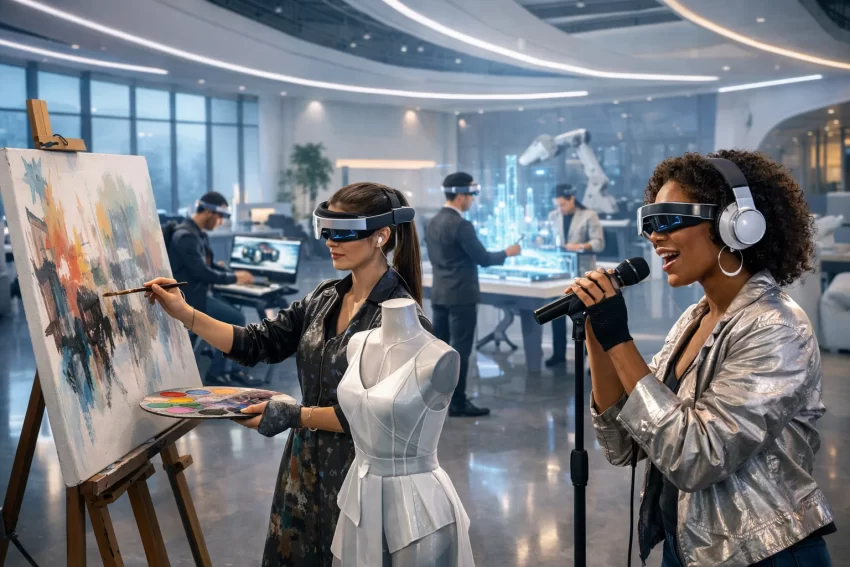
We are entering a new era of wearable technology. Not just fitness-bands or smartwatches, but cognitive wearables — devices and systems that augment human cognition, perception and decision-making. As someone with deep experience in physics and emerging tech, I believe this is where wearable innovation becomes truly transformative.
1. From Smartwatches to Smart Minds
Wearables started with step-counters, heart-rate monitors, insulin pumps. Today, they have become powerful: waterproof smartwatches, AR glasses, body-sensors. The next step: devices that directly engage with cognitive processes — memory assistance, real-time language translation, attention management, decision-support in dynamic contexts. The human-machine boundary starts to blur.
2. What “Cognitive Wearables” Actually Do
Key capabilities include:
- Continuous contextual sensing: The wearable knows your environment, schedule, biometric state, tasks.
- Adaptive AI-assisted support: The device offers recommendations, reminders, even anticipatory actions (e.g., “Your meeting is in 10 min, you are low on focus, would you like a micro-break?”).
- Seamless integration: Minimal friction — voice, gesture, glance. The technology fades into the background.
- Augmented cognition: For example, language translation on-the-fly, memory augmentation (recall prompts), or real-time data overlays in industrial settings (for field technicians).
3. Why It Matters Now
- Hardware readiness: Low-power processors, advanced sensors, miniaturised batteries, edge-AI – all support continuous wearable operation.
- AI maturity: Models for natural language, computer vision, predictive analytics are in practical use. Wearables can embed or stream to the cloud.
- Connectivity: 5G, edge computing and always-on devices mean wearables are not isolated — they’re part of a connected brain-ecosystem.
- Mobility & Empowerment: Modern business travellers (like myself) now expect full productivity when moving from airport to beach. Cognitive wearables support that freedom.
4. Use Cases Emerging Now
- Enterprise / Field operations: Technicians with smart glasses that overlay instructions, detect anomalies, summon remote experts.
- Healthcare / Assisted living: Wearables that monitor cognition, detect early signs of decline, support memory/attention.
- Professional productivity: Augmented reality plus AI-assistants in meetings, translations, note-taking, and decision-tracking.
- Consumer lifestyle: Smart eyewear that alerts you to social cues, monitors stress/attention, helps you optimise your day.
5. Challenges & Considerations
- Privacy & ethics: Cognitive data is intimate. Who owns the data? How is consent managed?
- User experience: Wearables must be light, comfortable, unobtrusive; cognitive-load must be minimal, not distracted.
- Battery life & form-factor: Real-time sensing + AI + connectivity = high energy demand; design constraints remain.
- Human-machine trust & adaptation: Users must trust the wearable’s suggestions; the system must learn from the individual.
- Regulation & safety: In medical or enterprise contexts, wearables may require certification or face liability.
6. My Travel-Frame Perspective
Having travelled extensively, I find that productivity isn’t just about connectivity — it’s about context. A wearable that understands you’re boarding a flight, signalling you’re tired, suggests a short cognitive-warm-up before the meeting, or auto-translates while you take a coffee in a foreign city — that’s the leap. Cognitive wearables enable mobility without compromise, and align perfectly with the “carry-only one light suitcase” philosophy of modern travelling professionals.
7. Strategic Advice for Startups & Investors
- Start with a niche, scale later: Pick a vertical where the value proposition is clear (field tech, healthcare) before broad consumer adoption.
- Focus on interaction, not just hardware: The value is in software + AI + UX as much as the sensor.
- Build ecosystem partnerships: With device makers, enterprise customers, regulatory bodies.
- Think privacy by design: Cognitive wearables will be judged as much on trust as on functionality.
- Align with mobility trends: 5G, edge-computing, low-power hardware — make the wearable part of the mobile productivity stack.
Conclusion
Cognitive wearables represent the next frontier of human–machine symbiosis. The line between seeing, thinking, acting and technology-assistance is fading. For professionals, travellers, innovators and entrepreneurs, the opportunity is vast: to be more capable, more mobile, more context-aware than ever before. The technology isn’t just smart — it’s becoming an extension of our cognition.
This blog post was written and photos are made with the assistance of Gemini, Copilot and ChatGPT, Sora based on ideas and insights from Edgar Khachatryan.