For most of the twentieth century, science advanced by going deeper into narrow corridors. Biologists studied cells. Computer scientists studied algorithms. Materials engineers studied matter at the atomic scale. Each discipline built its own language, its own institutions, its own definition of progress.
That era is ending.
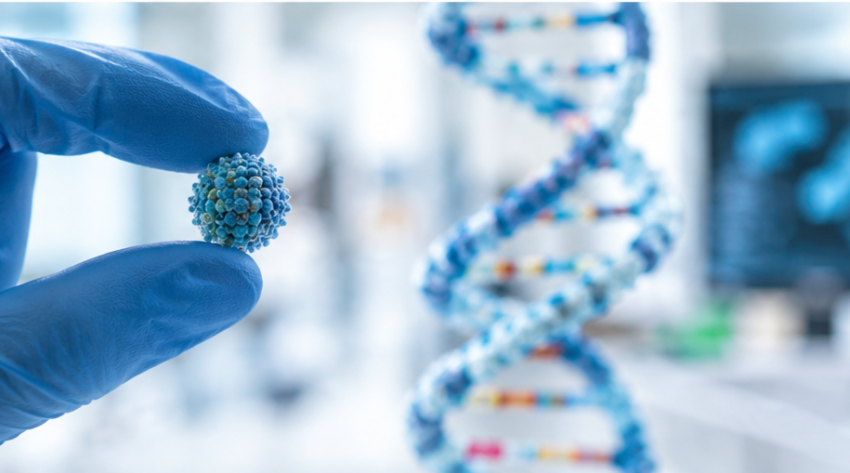
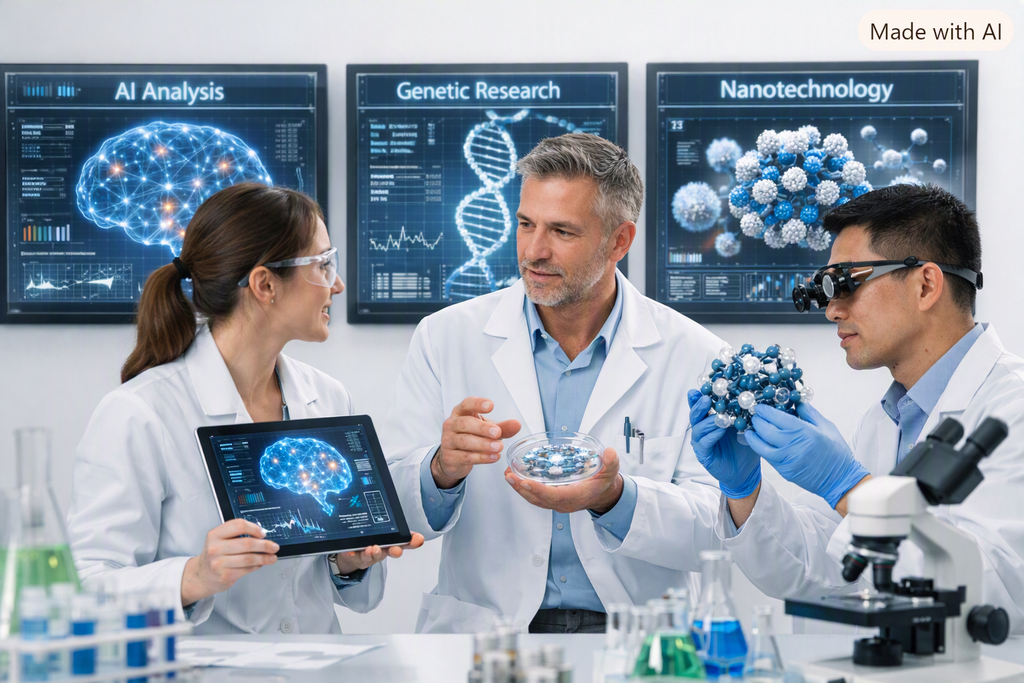
We are entering a period of bio-convergence — a fundamental merging of biotechnology, artificial intelligence, and nanotechnology into a single, unified technological frontier. This is not a metaphor for collaboration between disciplines. It is a structural transformation in how living systems, intelligent machines, and engineered matter interact at the most fundamental levels of reality.
The consequences — for medicine, industry, human identity, and civilization itself — will be profound.
Three Technologies, One Direction
To understand bio-convergence, it helps to see where each field currently stands.
Biotechnology has moved beyond simply reading the genome to actively rewriting it. CRISPR-based tools now allow precise edits to living DNA with therapeutic applications already in clinical use. Synthetic biology is engineering entirely new biological functions — organisms designed to produce medicines, absorb carbon, or signal the presence of disease.
Artificial intelligence has crossed from pattern recognition into reasoning, prediction, and generative capability. In life sciences, AI is now accelerating drug discovery by orders of magnitude, predicting protein folding structures that took decades to resolve experimentally, and identifying disease biomarkers invisible to human analysis.
Nanotechnology is gaining the precision to construct and manipulate structures at the scale of individual molecules. Lipid nanoparticles — the delivery mechanism behind mRNA vaccines — were among the first mainstream applications. Researchers are now developing nanostructures that can navigate the bloodstream, detect cancerous cells, and deliver therapeutic payloads with surgical accuracy.
Each of these fields is remarkable in isolation. Together, they are something categorically different.
Where the Boundaries Disappear
The most consequential developments in bio-convergence are happening precisely where these three fields overlap.
Consider AI-designed nanomedicines. Machine learning models can now screen millions of molecular configurations to identify nanoparticle structures optimized for specific biological targets — a process that would take human researchers years compressed into days. The AI does not merely assist; it generates designs that no human researcher would have intuitively proposed.
Or consider DNA-based data storage. Synthetic biology is making it possible to encode digital information directly into biological molecules, with AI managing the error-correction and retrieval systems. Living matter is becoming a computational substrate.
In neuroscience, brain-computer interfaces — already in early human trials — are bridging biological neural networks with external digital systems. AI interprets signals. Nano-scale electrodes make contact without the inflammation triggered by traditional materials. The boundary between biological intelligence and machine intelligence begins to blur.
This is not science fiction. These experiments are running in laboratories today.
The Industrial Implications
From a venture and business perspective, bio-convergence represents one of the largest economic opportunities in human history — and one of the most complex to navigate.
The market is not simply “biotech” or “AI” or “materials science.” It is an entirely new category that requires interdisciplinary expertise, long investment horizons, and regulatory frameworks that do not yet fully exist. Companies that treat bio-convergence as a subset of their existing industry will be outcompeted by those building natively at the intersection.
Several dynamics are already visible:
- Pharmaceutical pipelines are being restructured around AI-driven target identification and nano-scale delivery — reducing failure rates and compressing development timelines
- Agriculture is converging with synthetic biology and AI-powered sensing to engineer crops at the genomic level while monitoring field conditions in real time
- Defense and security sectors are investing heavily in bio-convergent technologies — from biosensors capable of detecting chemical threats to materials that self-repair
- Consumer health will shift from episodic treatment to continuous, personalized biological monitoring, enabled by nano-sensors and AI interpretation layers
Entrepreneurs who can operate across these boundaries — who speak the language of both the wet lab and the machine learning stack — will define the next generation of breakthrough companies.
The Questions We Are Not Ready to Answer
Bio-convergence does not arrive without profound ethical weight.
When nanotechnology can monitor biological processes inside the human body in real time, and AI can interpret that data to predict behavior, mood, or disease risk — who controls that information? When gene-editing tools become accessible and AI-accelerated, how do we govern their use across different regulatory environments and value systems?
These are not hypothetical concerns. They are engineering decisions being made right now, embedded in platform designs and research roadmaps that will be difficult to reverse once deployed.
Several critical questions need urgent, interdisciplinary attention:
- How do we establish consent frameworks for technologies operating at biological levels the individual cannot directly observe?
- How do we prevent bio-convergent capabilities from deepening global inequality between nations and populations that have access and those that do not?
- How do we build governance structures that are adaptive enough to keep pace with convergent innovation, without stifling it?
The technical velocity of bio-convergence is already outrunning our institutional capacity to respond. This gap is itself a risk that innovators, investors, and policymakers share responsibility for closing.
A New Definition of Life, Intelligence, and Matter
Perhaps the deepest implication of bio-convergence is philosophical.
For millennia, humans have treated life, mind, and matter as fundamentally distinct categories. Biology studied what was alive. Physics and chemistry studied inert matter. Philosophy and psychology studied mind. These categories shaped our institutions, our ethics, and our self-understanding.
Bio-convergence dissolves these distinctions experimentally. When engineered nanoparticles behave as biological agents, when AI models predict and influence biological processes, when synthetic biology writes new organisms from scratch — the old categories no longer cleanly apply.
We are not simply building better tools. We are redefining the material substrate of intelligence, health, and life itself.
That is an extraordinary moment to be alive. It demands the best of human curiosity, the sharpest ethical reasoning, and the most interdisciplinary thinking we can bring to bear.
The convergence has already begun. The question is not whether we will navigate it — but how wisely.
This blog post was written with the assistance of Claude (Anthropic) and ChatGPT based on ideas and insights from Edgar Khachatryan.