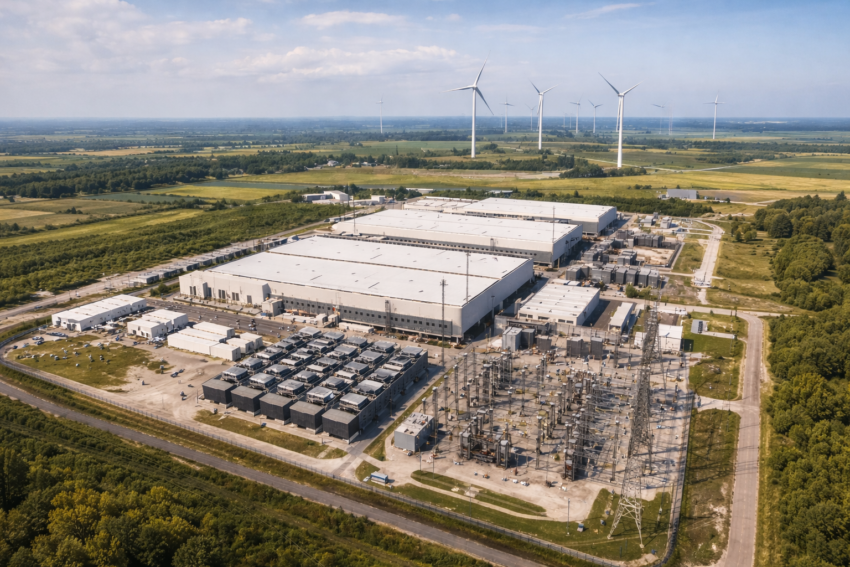
Artificial Intelligence dominates headlines. Chatbots answer customer questions, generate images, write code, and summarize documents. Yet behind every AI interaction — every prompt, every response, every generated image — lies something far larger and far less visible: a global infrastructure of data centers that is quietly reshaping energy markets, real estate, geopolitics, and the future of computing.
The real AI revolution is not happening on your screen. It is happening underground, in industrial facilities consuming as much electricity as small cities.
The Numbers Behind the Interface
When a user types a question into an AI assistant, the experience feels instant and effortless. What actually happens is computationally extraordinary. A single AI inference request — generating one response — can require thousands of specialized processors working in parallel for fractions of a second. At scale, across millions of simultaneous users, this translates into energy and infrastructure demands unlike anything the technology industry has previously managed.
By 2026, global data center electricity consumption is projected to exceed 1,000 terawatt-hours annually — comparable to the total electricity consumption of Japan. The hyperscalers — Microsoft, Google, Amazon, Meta — are investing hundreds of billions of dollars not into software, but into physical infrastructure: land, cooling systems, power grids, and custom silicon.
This is the invisible infrastructure of AI.
Why Data Centers Are the Real Competitive Moat
In traditional software, competitive advantage came from code — algorithms, user experience, network effects. In the AI era, competitive advantage increasingly comes from physical scale: how many GPUs you can deploy, how reliably you can cool them, how close you can locate facilities to renewable energy sources, and how efficiently you can manage power delivery.
NVIDIA’s dominance in AI chips has been widely discussed. Less discussed is the fact that owning the chips is only the beginning. The real constraint is deploying them at scale — which requires purpose-built facilities, dedicated fiber infrastructure, enormous water or air cooling systems, and reliable access to electricity that many regions simply cannot provide.
This is why the AI race has become, in part, an infrastructure race. Countries and corporations that control the physical layer of AI will hold disproportionate influence over the technology layer above it.

The Geography of AI Power
Data center investment is redrawing economic maps. Regions once overlooked — rural Virginia, the Irish midlands, northern Scandinavia, Malaysia’s Johor corridor — are becoming critical nodes of the global AI economy. The deciding factors are access to affordable land, stable power grids, moderate climates that reduce cooling costs, and favorable regulatory environments.
This geographic shift has significant implications for investors, policymakers, and entrepreneurs:
- Energy companies are suddenly strategic partners of the largest technology firms in history
- Real estate developers specializing in industrial facilities are experiencing demand unlike anything in prior technology cycles
- Governments are competing to attract data center investment through tax incentives, infrastructure commitments, and streamlined permitting
- Water utilities are negotiating with hyperscalers over cooling water rights in ways that would have seemed implausible a decade ago
The physical location of AI infrastructure is becoming a matter of national strategy.
Sustainability: The Pressure No One Can Ignore
The energy demands of AI infrastructure have placed the industry under intense sustainability scrutiny. Several hyperscalers made ambitious net-zero commitments before the AI boom dramatically increased their power consumption. Reconciling those commitments with the reality of exponential compute growth is now one of the most complex challenges in corporate sustainability.
The response is driving genuine innovation. Next-generation data centers are being designed around direct liquid cooling, where coolant flows directly to chip surfaces rather than relying on air conditioning of entire rooms. Nuclear power — long dismissed as politically unfeasible — is returning to serious consideration, with several major technology companies signing agreements with nuclear operators to secure long-term carbon-free baseload power.
The pressure to build AI infrastructure at speed while honoring sustainability commitments is creating one of the most dynamic engineering and policy environments of our era.
What Entrepreneurs and Investors Should Understand
The AI infrastructure opportunity extends far beyond the hyperscalers themselves. A dense ecosystem of specialized providers — colocation operators, cooling technology companies, power management specialists, modular data center manufacturers, fiber infrastructure developers — is emerging to serve the build-out.
From my experience observing technology transitions over 25 years, the most durable investment opportunities rarely sit at the visible frontier. They sit one layer below, in the infrastructure that makes the frontier possible. Just as the internet era created lasting value in fiber optic networks and cloud platforms rather than the websites that ran on them, the AI era is creating durable value in the physical and energy infrastructure that underlies every model, every API call, every inference.
The chatbot is the product. The data center is the factory. Investors who understand this distinction will be better positioned to navigate the decade ahead.
Looking Forward
The next generation of AI infrastructure will be defined by three forces: the relentless demand for more compute, the physical and environmental limits of current data center designs, and the geopolitical competition to control where and how that infrastructure is built.
Technologies on the horizon — photonic computing, new memory architectures, dedicated AI inference chips designed for energy efficiency rather than raw performance — may eventually reduce the infrastructure burden per unit of intelligence. But in the near term, the trajectory is clear: more compute, more power, more physical infrastructure.
Understanding AI through the lens of chatbots and language models is like understanding the industrial revolution through the lens of the goods it produced, while ignoring the factories, railways, and coal mines that made production possible.
The infrastructure is invisible to most users. It should not be invisible to those who want to understand where AI is truly heading.
This blog post was written with the assistance of Claude (Anthropic) and ChatGPT based on ideas and insights from Edgar Khachatryan.