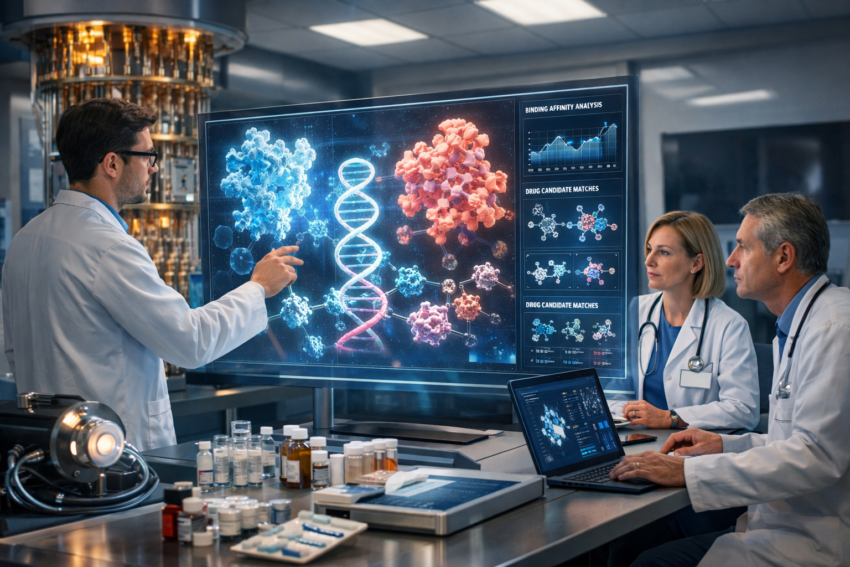
Introduction – The Quantum Revolution in Medicine
Quantum computing is poised to transform not only technology but also medicine and drug discovery. From its early development in labs to cloud-based services accessible to hospitals, quantum computing promises to accelerate protein modeling, optimize drug interactions, and enable truly personalized therapeutics.
To understand this transformation, we must examine: current quantum technologies, emerging qubit platforms, timelines for personal quantum devices, and how hospitals can access these capabilities.
1. Quantum Computing Technologies Today
Major companies are developing different qubit types, each optimized for distinct trade-offs in speed, coherence, and scalability:
| Company | Qubit Type | Strengths | Challenges | Market Readiness |
|---|---|---|---|---|
| Superconducting | Fast, chip integration | Decoherence, scaling | NISQ | |
| IBM | Superconducting | Cloud access, modular | Error correction overhead | NISQ & roadmap |
| D-Wave | Quantum Annealing | Large-scale optimization | Not universal | Commercial |
| IonQ/Quantinuum | Trapped-Ion | High fidelity, long coherence | Slower gates, complex laser control | Early commercial |
| PsiQuantum/Xanadu | Photonic | Room temperature, scalable | Photon loss, error correction | Prototype/NISQ |
| Microsoft | Topological (Majorana) | Fault-tolerant potential | Experimental | Lab/Prototype |
| Intel | Silicon Spin | CMOS-compatible, chip-scale | Coherence, scaling | Prototype |
Highlights:
- Superconducting and trapped-ion qubits dominate current practical applications.
- Photonic and topological qubits promise large-scale, low-error computation in the future.
- Hybrid quantum-classical systems are already showing value in research and optimization tasks.
2. Rarely Used or Experimental Qubit Technologies
Several promising approaches are not yet commercially deployed, offering potential breakthroughs for precision medicine:
- Neutral Atom Qubits (Rydberg states): Highly scalable, long coherence, early research-stage.
- Nuclear Spin Qubits: Ultra-stable memory qubits; experimental only.
- Quantum Dot Molecule Arrays: Multi-level qudits; experimental.
- Anyon-Based Topological Qubits Beyond Majorana: Fault-tolerant potential; lab prototypes.
- NV Centers & Rare-Earth Ion Qubits: Room-temperature quantum memory; experimental.
These technologies could enable compact, fault-tolerant systems suitable for personalized therapeutics in the future.
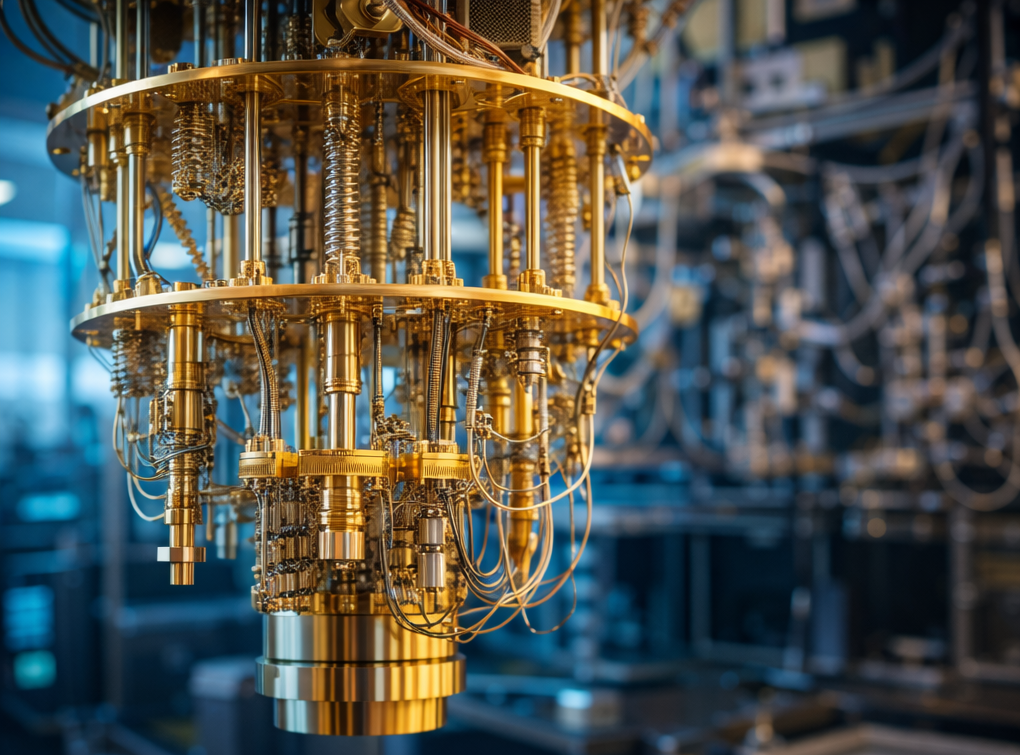
3. The Road to Personal Quantum Computers
The dream of laptop-sized quantum computers is still decades away. Main barriers: error correction, coherence, and cooling.
| Technology | Potential for Personal Devices | Cooling | Estimated Timeline |
|---|---|---|---|
| Majorana / Topological | High | mK | 2035–2045 |
| Silicon Spin | High | 10–100 mK | 2030–2040 |
| Photonic | Medium-High | Room Temp | 2035+ |
| Superconducting | Low | <20 mK | 2040+ |
| Trapped-Ion | Low | Complex optics | 2040+ |
Insight: Early versions (1–5 qubits) may appear 2030–2040 as desktop prototypes. Fault-tolerant personal quantum laptops are likely 2040–2050.
4. Quantum Computing in Drug Discovery and Protein Modeling
Evolution of Computational Approaches
| Era | Method | Speed | Scale | Precision | Personalization | Outcome |
|---|---|---|---|---|---|---|
| Manual | Human calculations | Weeks/months | Few proteins | Low | None | Low specificity, high failure |
| Classical Computers | MD simulations | Days–weeks | Hundreds of molecules | Moderate (~1 kcal/mol) | Limited | Reduced candidate pool |
| Supercomputers | HPC MD simulations | Hours–days | Millions of molecules | High (~0.5 kcal/mol) | Limited | Faster hit identification |
| AI + Big Data | Deep learning & chemical libraries | Seconds–hours | Whole proteomes | Very high | Moderate–high | Predictive candidates, mutation-specific |
| Quantum + AI + Big Data | Quantum simulations + AI | Hours | Multi-protein complexes | Extremely high (<0.1 kcal/mol) | Very high | Personalized therapeutics, unprecedented accuracy |
Impact on Drug Discovery
- Speed: Quantum + AI reduces simulation times from years to hours for complex proteins.
- Precision: Predicts molecular interactions with <0.1 kcal/mol error, capturing subtle mutations and allosteric effects.
- Personalization: Can model patient-specific proteins, metabolic pathways, and genetic variations for tailored therapeutics.
Example: Rare genetic mutations can be simulated to identify the most effective drug for a single patient or a small population.
5. Cloud-Based Quantum Medicine
Most hospitals will not host their own quantum computers due to cost, size, and expertise requirements. Instead, cloud-based quantum computing platforms will provide Software-as-a-Service (SaaS) access:
- IBM Quantum Cloud: Remote access to superconducting qubits for research and simulations.
- Amazon Braket: Multiple backends integrated with AI and big data pipelines.
- Microsoft Azure Quantum: Hybrid quantum-classical workloads for research labs.
- D-Wave Leap: Quantum annealing for optimization and early pharmaceutical applications.
Workflow for Hospitals:
- Upload patient-specific genomic/proteomic data.
- Run simulations for protein folding, drug binding, and metabolic interactions.
- AI interprets results and suggests personalized drug options.
Insight: This model allows small and large hospitals alike to access quantum-powered medicine without the infrastructure costs.
Conclusion – The Future of Personalized Medicine
Quantum computing, AI, and big data together are reshaping drug discovery:
- From months to seconds for complex simulations.
- From approximate predictions to near-perfect accuracy.
- From population-level medicine to patient-specific therapies.
Cloud-based platforms will democratize access, allowing hospitals and labs to leverage quantum capabilities without owning the hardware.
Vision: Within the next decade, personalized, highly effective, and safe therapeutics will become standard, reducing failures, side effects, and costs — a transformation comparable to the invention of the wheel in its impact on human life.
This blog post was written and photos are made with the assistance of Gemini, Copilot and ChatGPT, Sora based on ideas and insights from Edgar Khachatryan.