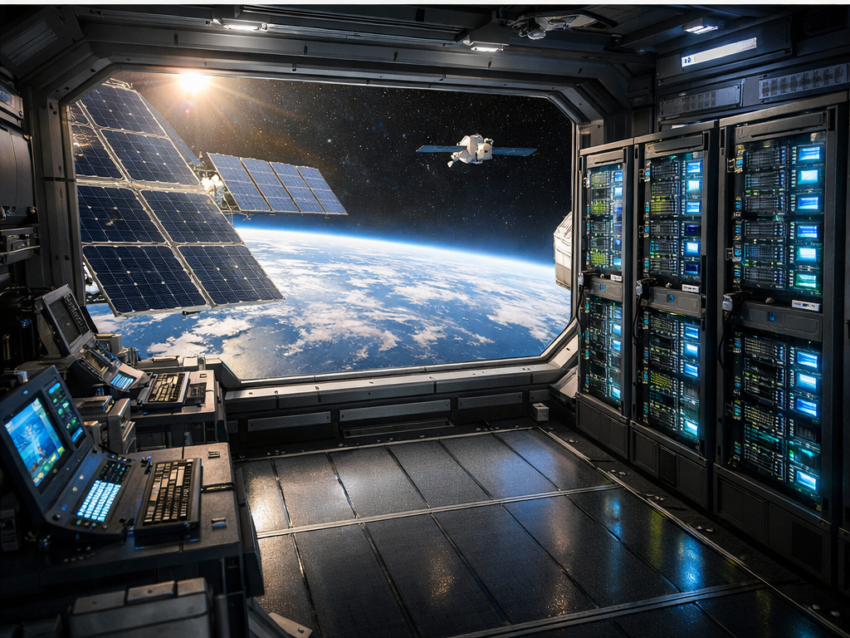
The digital economy has an infrastructure problem. Global demand for compute — driven by AI training, real-time analytics, and cloud services — is growing faster than the physical capacity to support it. Data centers are expanding at unprecedented rates, consuming vast amounts of land, water, and energy. According to the International Energy Agency, data centers already account for approximately 1–2% of global electricity consumption, and that figure is rising steeply.
Yet while engineers optimize cooling systems and squeeze more racks into terrestrial buildings, a fundamentally different solution is emerging on the horizon — quite literally: orbital computing infrastructure.
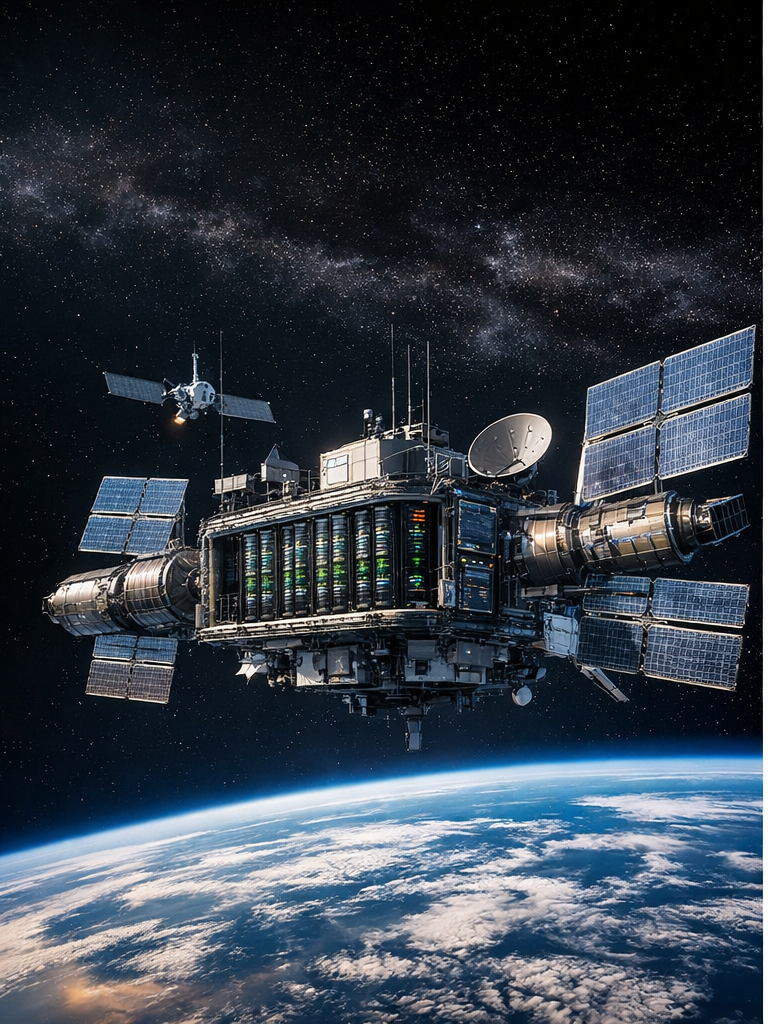
The next data center may not be in Virginia, Dublin, or Singapore. It may be 550 kilometers above Earth.
Why Terrestrial Infrastructure Is Approaching Its Limits
The constraints facing ground-based data centers are not merely logistical — they are physical:
- Thermal management: Cooling accounts for 30–40% of a typical data center’s energy consumption. Managing heat at scale is increasingly expensive and energy-intensive.
- Land and water scarcity: Hyperscale facilities require millions of liters of water daily for cooling. In drought-prone regions, this creates direct competition with human needs.
- Energy grid dependency: Data centers cluster near power sources, creating geographic concentration risks and transmission inefficiencies.
- Regulatory pressure: New EU and U.S. sustainability mandates are forcing operators to meet aggressive carbon targets, increasing operational complexity.
These are not problems that optimization alone can solve. They are signals that the current architectural paradigm for computing infrastructure has fundamental limitations.
The Physical Advantages of Orbital Computing
Space offers a radically different operating environment — one that eliminates several of the most costly constraints:
1. Natural Thermal Radiation In the vacuum of space, heat dissipates through radiation rather than convection. Satellites and orbital platforms can radiate excess heat directly into the cold of deep space (~3 Kelvin), potentially eliminating the need for active cooling systems entirely. This alone could reduce energy consumption by 30–40% compared to terrestrial equivalents.
2. Abundant Solar Energy In low Earth orbit (LEO), solar panels receive uninterrupted sunlight for up to 90% of an orbital period — with no atmospheric absorption losses. Solar energy density in space is approximately 1,361 W/m², compared to ground-level averages of 150–300 W/m² after atmospheric and weather losses. An orbital data center could theoretically be energy-self-sufficient.
3. Zero Land Use Orbital infrastructure requires no terrestrial real estate, no zoning permits, and no land rights negotiations. As real estate costs near major tech hubs soar, this represents a significant long-term economic advantage.
4. Latency Architecture Advantages Satellites in low Earth orbit — approximately 550 km altitude — can achieve round-trip signal latency of 20–40 milliseconds, comparable to many terrestrial fiber routes. For globally distributed edge computing, orbital nodes could offer superior performance to ground-based alternatives.
Current Initiatives and Emerging Players
The concept of orbital computing is no longer theoretical. Several organizations are actively building toward this future:
- Axiom Space and Starlab are developing commercial space stations that include research and computing modules, designed to operate beyond the retirement of the ISS.
- Lonestar Data Holdings has announced plans to deploy data centers on the Moon, beginning with lunar orbit missions targeted for the late 2020s.
- ThinkOrbital and OrbitsEdge are exploring satellite-based computing platforms specifically designed for AI inference workloads in LEO.
- Amazon Web Services and Microsoft Azure have both launched ground-based satellite connectivity services — a strategic step toward hybrid orbital-terrestrial architectures.
Critically, the declining cost of launch is making these initiatives economically viable. SpaceX’s Falcon 9 has reduced the cost per kilogram to LEO from approximately $54,000 in the Space Shuttle era to under $3,000 today. Reusable heavy-lift vehicles will push this further still.
The Challenges That Remain
Orbital computing is not without its obstacles. A realistic assessment must account for:
- Radiation hardening: Electronics in space are exposed to cosmic rays and solar particle events that can cause bit flips and component degradation. Radiation-hardened processors exist, but they are expensive and typically less performant than commercial chips.
- Servicing and maintenance: Unlike terrestrial data centers, orbital infrastructure cannot be easily repaired. Redundancy requirements add mass and cost.
- Data transmission bandwidth: Moving large volumes of data between orbital and ground infrastructure remains a bottleneck, though laser optical communication is rapidly improving — with systems like SpaceX’s Starlink laser inter-satellite links already demonstrating multi-gigabit throughput.
- Debris and orbital congestion: Low Earth orbit is increasingly crowded. Regulatory frameworks for managing orbital assets are still maturing, creating uncertainty for long-term capital investment.
- Launch cost per watt: Despite dramatic cost reductions, delivering and maintaining compute hardware in orbit still carries significant economic overhead compared to ground alternatives.
A New Computing Paradigm: Hybrid Orbital-Terrestrial Architecture
Rather than replacing terrestrial infrastructure, the most likely near-term outcome is a hybrid architecture — one in which orbital computing platforms handle specific workloads where the advantages are most pronounced:
- AI inference at global scale — running trained models close to satellite connectivity endpoints
- Remote sensing and Earth observation analytics — processing satellite imagery in orbit before transmission
- Defense and sovereign computing — jurisdictionally neutral orbital infrastructure for sensitive workloads
- Scientific simulation — high-performance computing for climate modeling, genomics, and physics research
Ground-based infrastructure will remain dominant for latency-sensitive, high-bandwidth workloads. But the computing landscape will increasingly resemble a three-dimensional network — ground, air (edge computing), and orbit — rather than the flat, terrestrial model of today.
The Investor and Entrepreneur Perspective
For those watching technology investment cycles, orbital computing represents a classic infrastructure wave — analogous to the build-out of undersea fiber cables in the 1990s or hyperscale cloud data centers in the 2010s. Each wave initially appeared premature, capital-intensive, and speculative. Each became foundational.
Key signals to watch:
- Government procurement: NASA, ESA, and defense agencies are early customers for orbital computing services — institutional validation that accelerates commercial development
- Launch cadence: As launch frequency increases and costs fall, the economics improve nonlinearly
- Chip miniaturization: Advances in low-power, high-performance processors (driven by mobile and edge computing) directly benefit orbital deployments
- International competition: China’s Tiangong space station includes dedicated computing modules — geopolitical competition is an underappreciated accelerant
The window for early positioning in orbital computing infrastructure is open — but not indefinitely.
Conclusion
Computing has always followed energy and physics. We built data centers near rivers for cooling, near power plants for electricity, and near urban centers for connectivity. Space represents the next logical step in this progression — an environment with abundant solar energy, natural thermal radiation, and a vantage point that serves the entire planet simultaneously.
The barriers are real: radiation, servicing costs, bandwidth, and debris. But so were the barriers to building the first transcontinental railroads, the first undersea cables, and the first commercial satellite networks. Each generation of infrastructure pioneers faced skeptics who counted the obstacles without accounting for the compounding power of technological progress and economic incentive.
The question is not whether orbital computing will emerge as a viable infrastructure paradigm. The question is who will build it, and when.
For entrepreneurs, investors, and technologists paying attention today, the answer to that question may define the next decade of the digital economy.
This blog post was written with the assistance of Claude (Anthropic), ChatGPT and Copilot based on ideas and insights from Edgar Khachatryan.