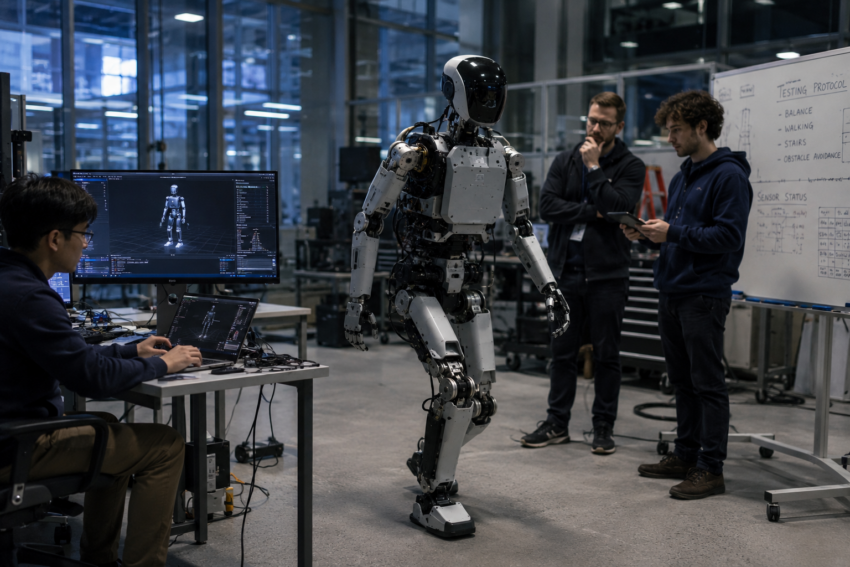
Artificial Intelligence has spent its first decades living entirely in the digital realm — processing text, recognizing images, generating content, and optimizing algorithms at speeds no human could match. Yet despite this remarkable progress, AI has remained fundamentally disembodied. It thinks, but it cannot act in the physical world.
That is about to change.
Physical AI — the convergence of advanced AI models with robotics, sensors, and autonomous hardware — represents the next great leap in technological evolution. It is the moment intelligence gains hands, eyes, and the ability to navigate the messy, unpredictable complexity of the real world.
From Screens to the Physical World
For most of its history, AI has operated behind glass. Its breakthroughs happened in data centers and appeared on screens. Even the most powerful language models — capable of passing bar exams and writing code — cannot pick up a dropped object, navigate a warehouse floor, or assemble a product on a factory line.
Physical AI closes that gap. It combines three converging capabilities:
- Perception — understanding the physical environment through cameras, LiDAR, tactile sensors, and spatial awareness
- Reasoning — interpreting complex, dynamic situations and making real-time decisions
- Action — executing precise physical movements through robotic systems, exoskeletons, autonomous vehicles, and industrial machinery
When these three layers work together seamlessly, machines stop being tools and start becoming agents.
Why Now?
The conditions for Physical AI have been building for years, but 2024–2026 marks a genuine inflection point. Several developments have converged simultaneously.
First, foundation models — the same large-scale AI architectures that power ChatGPT and its successors — are now being adapted for physical tasks. Companies are training robots not with hand-coded rules, but with general-purpose AI that learns from observation and experience.
Second, sensor technology has advanced dramatically in both capability and cost. High-resolution spatial computing, computer vision, and force-feedback systems now fit into compact, affordable hardware packages that would have seemed impossible a decade ago.
Third, simulation environments allow AI systems to learn physical tasks by practicing billions of iterations in virtual space before ever touching the real world. This dramatically accelerates training timelines and reduces the risk of costly physical errors.
The convergence of these factors means Physical AI is no longer a research concept — it is entering commercial deployment.
Where Physical AI Will Transform Industries
The implications reach far beyond humanoid robots in factory settings. Physical AI will reshape entire sectors:
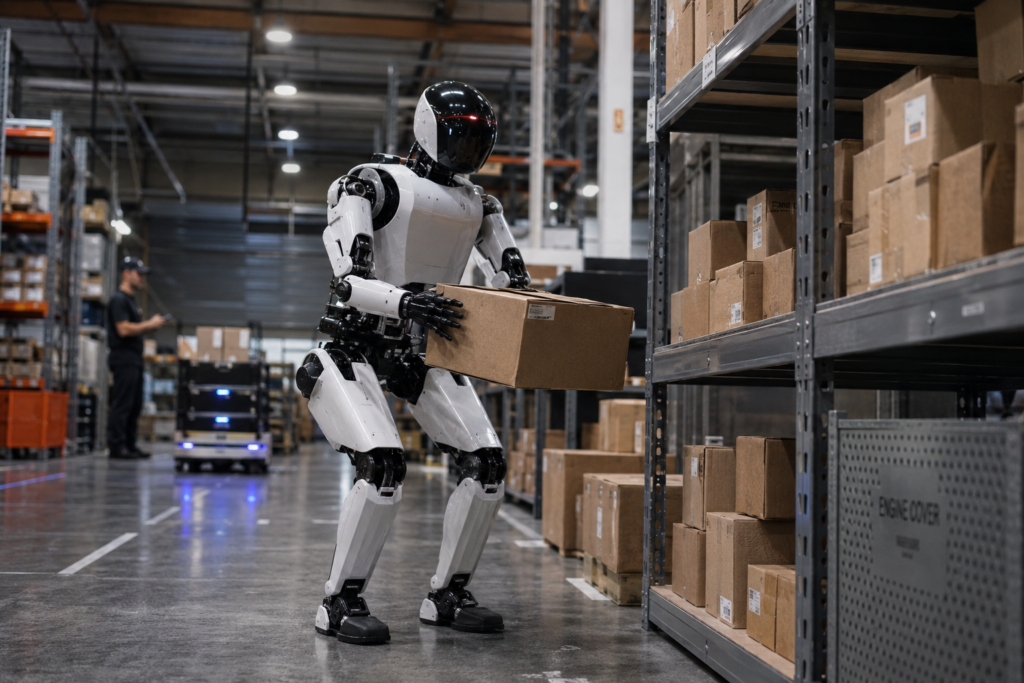
Manufacturing and Logistics — Autonomous robots are already moving inventory in warehouses, but next-generation systems will handle complex assembly tasks that previously required highly skilled human hands. Flexible, adaptable robotic workers will reduce production costs and enable hyper-customized manufacturing at scale.
Healthcare and Surgery — Robotic surgical systems guided by AI will achieve precision levels that exceed human physical capability. Beyond surgery, AI-powered exoskeletons will help patients recover from injuries, and autonomous systems will assist elderly individuals with daily mobility.
Agriculture — Intelligent machines will monitor soil conditions, harvest crops with precision, and respond to environmental changes in real time — addressing labor shortages while dramatically improving yield efficiency.
Construction and Infrastructure — Physical AI will operate in dangerous, unstructured environments where human safety is at risk: inspecting bridges, repairing pipelines, and constructing buildings in conditions too hazardous for human workers.
Defense and Emergency Response — Autonomous systems will conduct search and rescue operations, defuse hazardous materials, and operate in disaster zones where human presence is impossible.
The Central Challenge: Trust in the Physical World
Digital AI makes mistakes that can be corrected with a new prompt or a system update. Physical AI makes mistakes that can break equipment, disrupt operations, or harm people. The stakes of reliability are fundamentally different when intelligence operates in the real world.
This creates three critical challenges that will define the Physical AI era:
- Safety and fail-safe design — How do we ensure that autonomous physical systems behave predictably under unexpected conditions?
- Human-machine collaboration — How do we design interfaces that keep humans meaningfully in control without sacrificing the speed and autonomy that make these systems valuable?
- Regulatory frameworks — How do governments and industries establish standards for autonomous physical agents operating in shared human environments?
Solving these challenges will require collaboration across engineering, ethics, policy, and design — not just technical optimization.
The Economic Scale of the Opportunity
The Physical AI market is projected to become one of the largest technology sectors of the coming decade. Goldman Sachs and other analysts estimate that humanoid robots alone could represent a multi-trillion dollar market by the 2030s. When autonomous vehicles, industrial robotics, agricultural automation, and medical systems are included, the economic transformation rivals the industrial revolution in scope.
For entrepreneurs and investors, this creates opportunity at every layer of the stack — from specialized sensors and actuators to the AI training infrastructure that powers physical intelligence, to the application-layer companies deploying these systems in specific industries.
Toward a World of Intelligent Agents
Ultimately, Physical AI represents something more profound than a new product category. It marks the moment when artificial intelligence begins to share our physical world — not as a tool we reach for, but as an agent that operates alongside us.
In such a future, the boundaries between digital and physical intelligence will blur. Factories will think. Buildings will adapt. Vehicles will collaborate. Agricultural systems will respond to the environment with the sensitivity of an experienced farmer.
The question is no longer whether Physical AI will transform the world. It is whether we will design that transformation thoughtfully — building systems that amplify human capability rather than diminish human purpose.
The intelligence that once lived behind our screens is learning to walk. The next era of innovation will be defined by what it does when it does.
This blog post was written with the assistance of Claude (Anthropic) and ChatGPT based on ideas and insights from Edgar Khachatryan.