
For decades, space was the domain of governments — a symbol of national prestige, scientific ambition, and geopolitical competition. Today, it is becoming something else entirely: a rapidly emerging commercial market.
The shift is not incremental. It is structural.
Launch costs are falling. Private capital is flowing. Entire industries are being rebuilt with space infrastructure as a foundation. What used to be “the final frontier” is now becoming a business frontier — and investors are starting to pay attention.
The next decade will determine who captures the value.
From Exploration to Infrastructure
The first era of space was about exploration. The next is about infrastructure.
Satellites are no longer just scientific tools — they are part of global digital architecture. Communications, navigation, climate monitoring, defense systems, and financial networks increasingly rely on space-based assets.
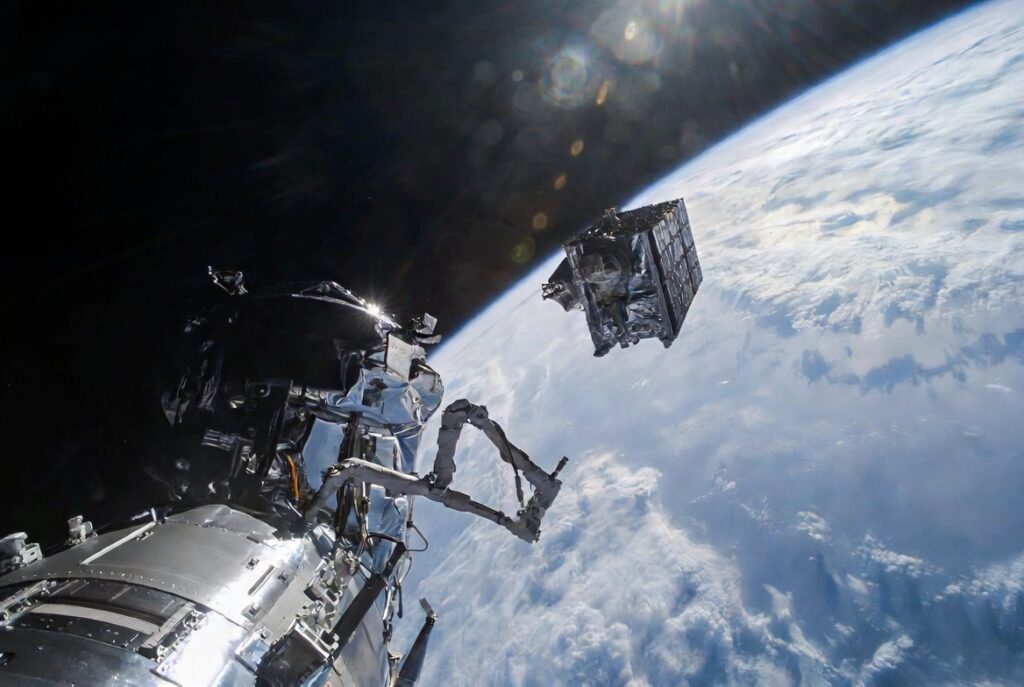
Low Earth Orbit (LEO) is turning into a crowded layer of economic activity. Thousands of satellites are being deployed not for prestige, but for revenue.
This matters because infrastructure businesses tend to be:
- Capital intensive
- Defensible
- Long-term
In other words, investable.
The Cost Curve Is Changing Everything
The single most important variable in the space economy is cost.
Historically, launching payloads into orbit was prohibitively expensive. That constraint limited innovation. Today, reusable rockets and improved manufacturing are compressing costs dramatically.
Lower launch costs unlock new business models:
- More frequent deployments
- Smaller, specialized satellites
- Faster iteration cycles
This mirrors what happened in cloud computing. Once infrastructure becomes cheaper and more accessible, application layers emerge rapidly.
Space is entering its “cloud moment.”
The Stack Is Expanding
To understand where value will be created, it helps to think in layers:
1. Launch (Access to Space)
Still capital-heavy, with high barriers to entry. A few dominant players are likely to capture most of the value.
2. Infrastructure (Satellites, Stations, In-Orbit Services)
This layer is scaling fast. It includes communication constellations, Earth observation networks, and emerging in-space manufacturing capabilities.
3. Data & Applications
The highest upside may be here. Satellite data is being turned into products for industries like agriculture, logistics, insurance, and defense.
Historically, the largest returns in technology come from the application layer — not the infrastructure itself.
The same pattern may repeat in space.
New Markets Are Emerging
Several markets are moving from concept to early commercialization:
Earth Observation & Analytics
High-frequency, high-resolution data is enabling real-time insights into supply chains, natural resources, and geopolitical risk.
Space-Based Internet
Global broadband coverage is no longer theoretical. It has direct implications for emerging markets, remote operations, and defense.
In-Orbit Services
Satellite maintenance, refueling, and debris management could become essential as orbital congestion increases.
Space Manufacturing
Microgravity environments open possibilities for materials and pharmaceuticals that cannot be produced on Earth — still early, but strategically important.
Each of these markets has different timelines and risk profiles. Not all will scale at the same pace.
The Role of Governments Has Not Disappeared
Commercialization does not mean governments are stepping back.
In fact, public sector demand remains a major driver:
- Defense contracts
- National security priorities
- Scientific funding
Government agencies are becoming anchor customers for private companies.
This creates a hybrid market — part commercial, part strategic — where policy and geopolitics still matter.
For investors, this means that understanding regulatory environments is just as important as understanding technology.
Capital Is Moving, but Selectively
Venture capital has already entered the space sector, but the enthusiasm is becoming more disciplined.
The early phase was driven by vision. The next phase will be driven by:
- Unit economics
- Scalability
- Time to revenue
Not every space startup is a good investment.
The capital intensity of the sector creates a natural filter. Companies that cannot demonstrate clear paths to monetization will struggle.
Risks Are Real — and Structural
The opportunity is significant, but so are the risks:
- Capital Requirements: Many companies require sustained funding before generating revenue
- Regulatory Complexity: Licensing, spectrum allocation, and international law add friction
- Technological Uncertainty: Not all innovations will work at scale
- Orbital Congestion: Space debris and traffic management are becoming critical issues
This is not a typical software market.
It requires patience, expertise, and a long-term perspective.
Where Investors Should Focus
The most interesting opportunities may not be where the attention currently is.
Instead of focusing only on launch providers, investors should look at:
- Data-driven applications built on top of space infrastructure
- Vertical-specific solutions (agriculture, energy, logistics)
- Enabling technologies that reduce cost or improve reliability
In other words, the “picks and shovels” — and the software layer on top of them.
The Bigger Picture
Space is not just another sector. It is an extension of the global economy.
What cloud computing did for digital infrastructure, space may do for physical and data infrastructure on a planetary scale.
The companies being built today are not just launching satellites. They are building the backbone of future industries.
For investors, the question is not whether space will become commercial.
It already is.
The real question is: where in the value chain the durable returns will be created — and who will capture them.
This blog post was written with the assistance of Grok. Claude (Anthropic), ChatGPT and Copilot based on ideas and insights from Edgar Khachatryan.