Every year, the world spends hundreds of billions of dollars repairing infrastructure that was never designed to repair itself. Bridges crack, pipelines corrode, concrete crumbles — and humanity sends out repair crews, closes lanes, and pays the bill. Over and over again.
What if the material itself could respond to damage the way living tissue does?
Self-healing materials are no longer science fiction. They represent one of the most consequential advances in materials science of the past decade — and their commercial breakthrough could fundamentally change how we build, maintain, and think about infrastructure.
The Scale of the Problem
The American Society of Civil Engineers estimates that the United States alone faces an infrastructure funding gap in the trillions. Globally, the numbers are staggering. Roads deteriorate faster than they are repaired. Bridges age beyond their design life. Water pipes leak silently underground for years before failure becomes visible.
The core issue is not just money — it is the fundamental assumption embedded in every structure we build: that materials are passive. Once damage begins, it progresses. Maintenance is reactive by design.
Self-healing materials challenge that assumption at the molecular level.
How It Actually Works
Nature solved the self-repair problem billions of years ago. Bone regrows. Skin closes. Plant tissue regenerates. Materials scientists have spent decades reverse-engineering these biological principles into synthetic systems.
There are currently three main approaches:
Microencapsulation embeds tiny capsules filled with healing agents directly into a material — concrete, polymer, or composite. When a crack propagates, it ruptures the capsules, releasing the agent which then reacts with a catalyst already present in the material and seals the damage. The process is automatic, triggered by the crack itself.
Vascular networks take a more sophisticated approach, embedding a network of channels — analogous to a circulatory system — that can continuously supply healing agents to damaged zones. Unlike capsules, which are single-use, vascular systems can enable repeated healing cycles.
Intrinsic healing is perhaps the most elegant mechanism. Certain polymers and hydrogels are engineered with reversible chemical bonds — when broken, they naturally reform under heat, light, or simple contact. No external agent is required. The material’s own molecular architecture enables recovery.
Each approach has different trade-offs in cost, durability, and number of healing cycles — but all three are moving from laboratory demonstrations to real-world applications.
Where the Breakthroughs Are Happening
Concrete is arguably the highest-value target. It is the most widely used construction material on Earth, and its failure modes — micro-cracking, rebar corrosion, water infiltration — are well understood and enormously costly. Researchers at Delft University have pioneered bioconcrete, embedding bacteria spores and their calcium lactate food source into the mix. When water enters a crack and activates the bacteria, they produce calcium carbonate — limestone — that fills the void. The spores remain dormant for decades and activate only when needed.
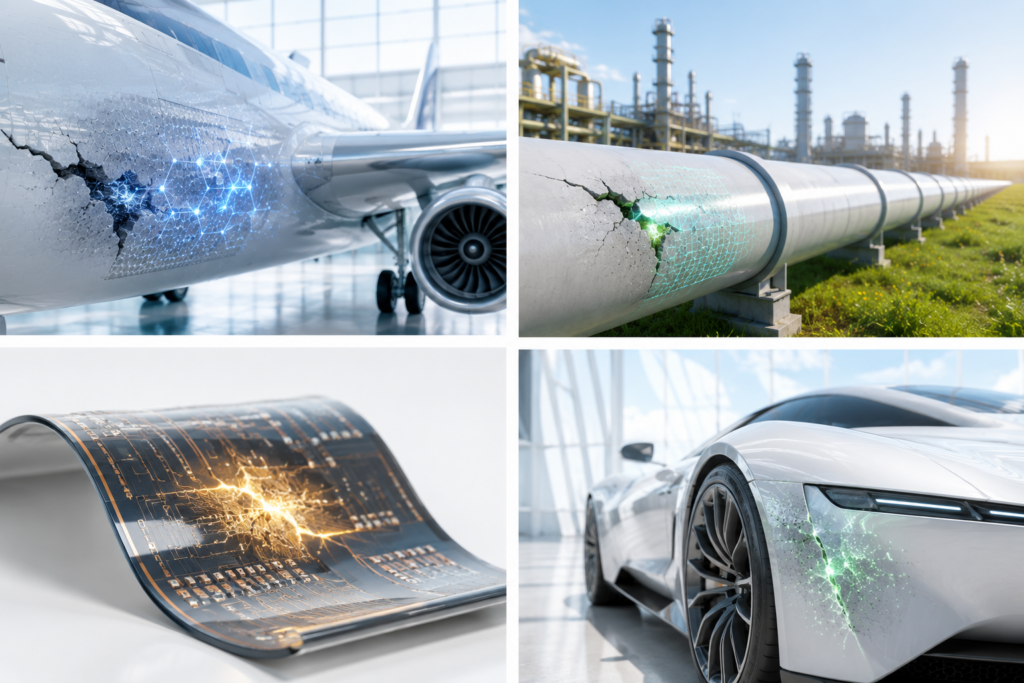
In aerospace and automotive engineering, self-healing polymers and composites are being developed for structural panels, coatings, and adhesives. The value proposition here is not just maintenance cost — it is safety. A material that signals or repairs micro-damage before it becomes catastrophic failure has obvious appeal in aviation.
In electronics, self-healing substrates could extend the life of flexible displays, wearable devices, and circuit boards — reducing both waste and replacement cost.
The Economic Case
The economic argument for self-healing materials is compelling even at current costs. Consider a highway bridge with a 75-year design life. Conventional concrete requires significant maintenance interventions every 10–15 years. Self-healing concrete, even at a 20–30% premium in initial material cost, could extend inspection cycles, reduce repair frequency, and meaningfully lower lifetime cost of ownership.
For pipeline infrastructure — where leaks represent both economic loss and environmental liability — the case is even more direct. A pipe that seals micro-fractures before they propagate is a pipe that does not become an emergency.
The true economic unlock will come when these materials reach production scale. Right now, cost remains the primary barrier to widespread adoption. But the trajectory of materials science suggests that barrier is narrowing.
Investment and Commercialization Signals
The startup landscape around self-healing materials is growing. Venture capital has begun flowing into companies working on self-healing coatings, concrete additives, and polymer systems. Large construction companies and material suppliers — BASF, Sika, Holcim — are running R&D programs and piloting these technologies in real projects.
Government agencies, from the U.S. Department of Transportation to the European Commission, are funding research and beginning to include self-healing concrete specifications in infrastructure procurement. When regulators start writing standards, it signals that a technology is transitioning from experimental to deployable.
For entrepreneurs and investors, the pattern here is familiar: a transformational technology that solves a massive, well-quantified problem, crossing from laboratory to commercial feasibility over a decade of incremental progress. The window for early positioning is still open.
Toward Infrastructure That Thinks for Itself
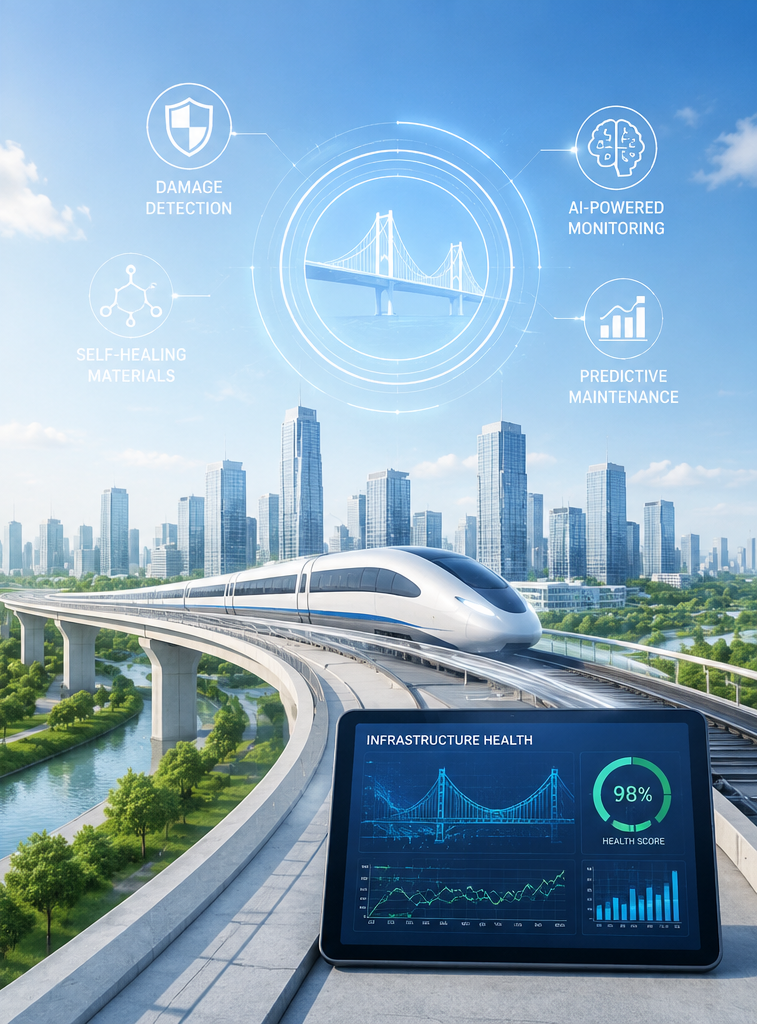
Self-healing materials are part of a broader convergence that I find deeply compelling. When you combine materials that can sense and repair damage with embedded sensors, AI-driven monitoring systems, and digital twins of physical infrastructure — you are no longer building passive structures. You are building infrastructure that has, in a meaningful sense, a feedback loop with its own condition.
A bridge that detects a crack, initiates a healing response, and reports its structural health to a monitoring system is qualitatively different from the bridges we build today. It is not just more durable — it is more intelligent.
This convergence — materials science meeting AI, biology meeting engineering — represents one of the more interesting innovation frontiers of the coming decade. The science is ready. The economic case is clear. The question is how quickly industry, investors, and policymakers will align to scale it.
The infrastructure we build in the next thirty years does not have to age the way everything before it did.
This blog post was written with the assistance of Claude (Anthropic) and ChatGPT based on ideas and insights from Edgar Khachatryan.