The physical world has always set the limits of what industry can achieve. Factories wear down. Pipelines corrode. Engines fail without warning. For centuries, the only way to understand a complex system was to build it, run it, and learn from its failures — often at enormous cost.
Digital twins are changing that equation.
A digital twin is a dynamic, real-time virtual replica of a physical object, process, or system. It is continuously updated by sensors, data feeds, and simulations, evolving in parallel with its physical counterpart. It does not merely model a system — it mirrors it, moment by moment, decision by decision.
What began as a niche concept in aerospace engineering has quietly become one of the most consequential technologies of our era. And most people have never heard of it.
From NASA to the Factory Floor
The roots of digital twin technology stretch back to NASA’s Apollo program, where engineers maintained parallel physical models of spacecraft to simulate emergencies from the ground. The term itself was formalized in the early 2000s by Dr. Michael Grieves at the University of Michigan, who described a product lifecycle management framework built around a virtual representation of a physical product.
For years, the concept remained largely theoretical — the computing power and sensor infrastructure required to make it practical simply did not exist at scale. That has changed dramatically. The convergence of IoT connectivity, cloud computing, AI-driven analytics, and 5G networks has transformed digital twins from an engineering thought experiment into an operational reality.
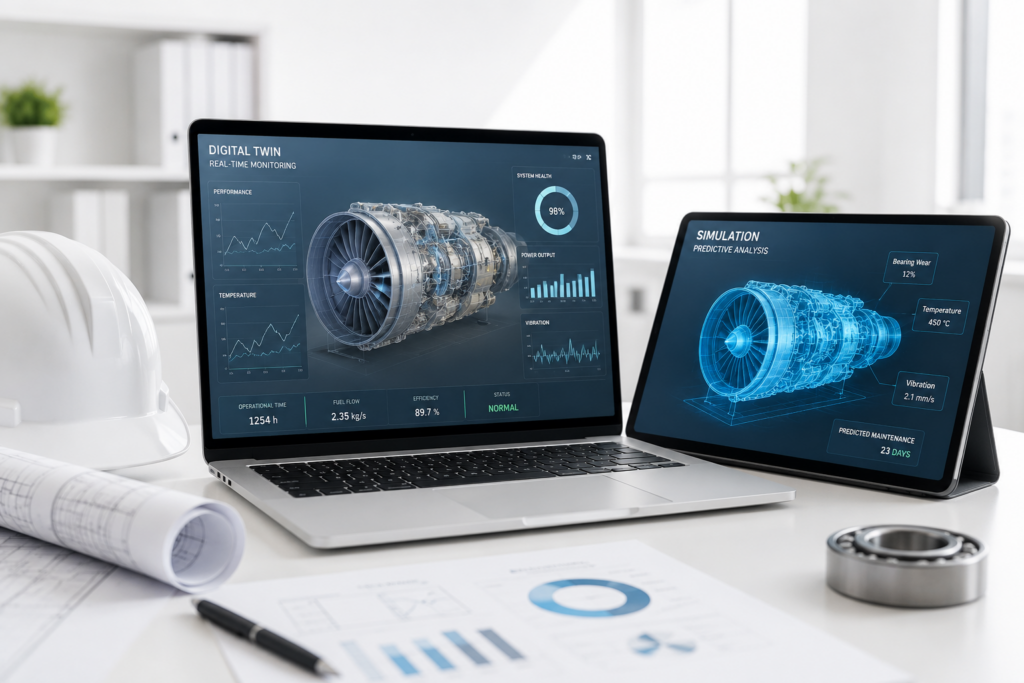
Today, Siemens runs digital twins of entire factories. Rolls-Royce uses them to monitor jet engines in real time across thousands of commercial flights. Singapore has built a digital twin of the entire city to model urban planning, traffic flows, and disaster response. The technology is no longer on the horizon — it is already reshaping how the world’s most complex systems are designed, operated, and maintained.
Why Digital Twins Matter Now
The timing of this technology is not coincidental. Industry is facing a convergence of pressures that traditional approaches cannot resolve.
Supply chains have become too complex to manage through historical data alone. Climate commitments are forcing industries to optimize energy consumption with precision that manual systems cannot achieve. Infrastructure around the world is aging faster than it can be replaced. And global competition is compressing the margins for error to near zero.
Digital twins address each of these challenges at the root.
A manufacturer running a digital twin of its production line can detect the early signatures of equipment failure weeks before it occurs — not by guesswork, but because the model has learned the normal behavioral patterns of every component in the system. A city managing a digital twin of its water distribution network can identify micro-leaks, pressure anomalies, and contamination risks in real time, before they escalate into crises. An energy company operating a digital twin of its grid can simulate the impact of renewable integration, demand spikes, or extreme weather events — and respond proactively rather than reactively.
This shift from reactive to predictive management is not incremental. It represents a fundamental change in the relationship between human decision-makers and the systems they oversee.
The Architecture of a Digital Twin
Understanding why digital twins are powerful requires understanding what they actually consist of. A mature digital twin has three essential components working in concert.
The first is data integration — the continuous flow of real-world information from sensors, operational systems, and external data sources into the virtual model. Without high-quality, high-frequency data, a digital twin is merely a static simulation.
The second is simulation and modeling — the computational layer that interprets incoming data, runs physics-based or AI-driven models, and generates predictions about future states. This is where the intelligence lives.
The third is feedback loops — the mechanisms by which insights from the digital twin translate back into real-world decisions. A digital twin that produces insights no one acts on is not a strategic asset; it is an expensive dashboard.
The sophistication of each layer determines how much value a digital twin delivers. Organizations that treat digital twins as a monitoring tool — rather than a decision-making engine — are capturing only a fraction of the potential.
Industries Being Transformed
The impact of digital twins is not confined to any single sector. The technology is crossing industry boundaries with remarkable speed.
In manufacturing, digital twins are enabling what industry analysts call “zero-defect production” — the ability to identify quality deviations in real time and correct them before defective products leave the line. Companies like BMW and General Electric have integrated digital twins deeply into their production systems, with measurable reductions in downtime and waste.
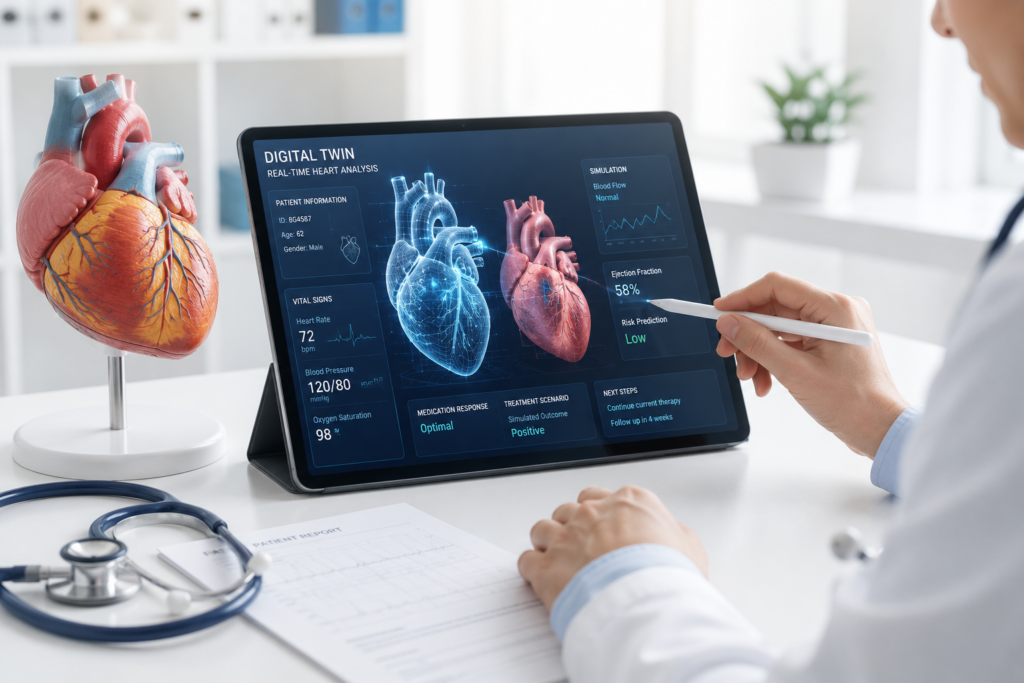
In healthcare, digital twins of human organs and physiological systems are moving from research labs into clinical practice. Personalized cardiac models are already being used to simulate how individual patients will respond to specific treatment protocols before any intervention begins. The implications for drug development and surgical planning are profound.
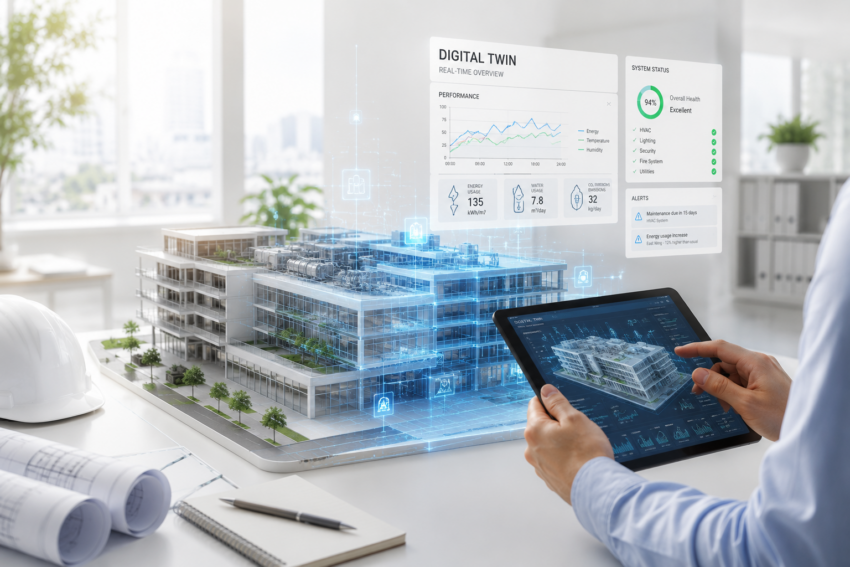
In construction and real estate, building information modeling is evolving into full digital twin architectures that track a structure’s performance across its entire lifecycle — from design and construction through decades of operation and eventual decommissioning.
In energy and utilities, digital twins of power grids, pipelines, and offshore platforms are becoming essential infrastructure for managing the complexity of the energy transition. The ability to simulate grid behavior under variable renewable inputs is no longer a competitive advantage — it is becoming an operational necessity.
The Deeper Shift: From Products to Living Systems
What makes digital twins genuinely revolutionary is not any single application. It is the conceptual shift they represent in how we think about physical systems.
Traditionally, a product was designed, manufactured, sold, and eventually discarded. The relationship between creator and creation ended at the point of sale. Digital twins break that model entirely. A product with a digital twin maintains a continuous, bidirectional relationship with its creators and operators throughout its entire life. It communicates. It evolves. It improves.
This transforms the economics of almost every industry it touches. Instead of selling a jet engine, Rolls-Royce sells thrust — a performance-based model only possible because digital twins allow continuous monitoring and optimization of every engine in the fleet. Instead of selling industrial equipment, companies increasingly sell operational outcomes, with digital twins as the infrastructure that makes the guarantee credible.
The product is becoming a service. The asset is becoming a relationship.
Challenges That Remain
Digital twins are not without their obstacles. Data security is a serious concern — a digital twin is only as trustworthy as the data feeding it, and a compromised data stream can produce dangerously misleading outputs. Organizations operating critical infrastructure through digital twin frameworks must invest heavily in cybersecurity architecture.
Interoperability remains a significant challenge. Many industries are still working with legacy systems that were never designed to generate or transmit the structured data streams digital twins require. Building the sensor infrastructure and data pipelines necessary to support a mature digital twin deployment is neither cheap nor simple.
And the human dimension cannot be overlooked. Digital twins generate enormous volumes of insight. Converting that insight into organizational decisions requires new skills, new workflows, and a cultural willingness to trust model outputs over intuition. That transition is often harder than the technology itself.
Looking Ahead
The digital twin market is projected to grow from roughly $17 billion today to well over $100 billion by the end of the decade. But market size statistics miss the deeper story.
What is emerging is not just a technology market. It is a new layer of infrastructure for the physical world — an invisible nervous system that runs in parallel with factories, cities, hospitals, and grids, continuously sensing, learning, and optimizing.
The companies and governments that understand this early will not simply gain an efficiency advantage. They will redefine what efficiency means in their industries. They will compress the distance between a problem and its solution from months to minutes. They will make decisions that their competitors cannot even see.
The next industrial revolution will not be announced by a single invention or a dramatic public moment. It will unfold quietly, in data centers and server rooms, in the continuous hum of sensors and models and feedback loops.
The invisible engine is already running.
This blog post was written with the assistance of Claude (Anthropic), ChatGPT and Copilot based on ideas and insights from Edgar Khachatryan.