
Medicine has always aspired to treat the individual. Yet for most of its history, it has treated the average. A drug approved for millions is calibrated to a statistical middle ground — effective for many, suboptimal for some, harmful for a few. That era is drawing to a close. Personalized gene editing is no longer a theoretical promise. It is an emerging reality that will redefine what medicine means for every human being on the planet.
1. From One-Size-Fits-All to One-of-a-Kind
The traditional pharmaceutical model is built on population-level data. Clinical trials measure average outcomes. Dosage guidelines reflect average body weight, average metabolism, average risk. But biology is not average. Two patients with identical diagnoses can have fundamentally different genetic profiles — meaning the same treatment can cure one and devastate the other.
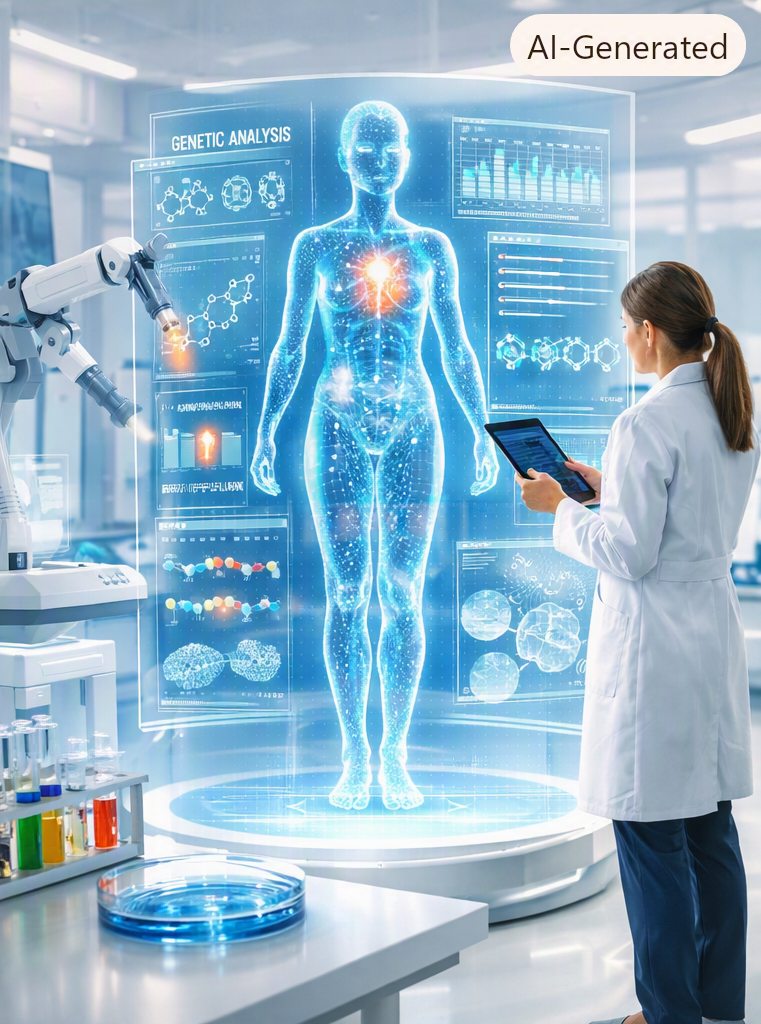
Personalized gene editing flips this model entirely. Instead of designing a therapy for a population, scientists now design therapies for a single individual — editing specific mutations in that person’s DNA with molecular precision. The drug is the patient. The treatment is the genome.
This is not incremental improvement. It is a categorical shift in what medicine can do.
2. CRISPR and the Toolkit of Precision
The key enabling technology is CRISPR-Cas9 — a molecular scissors system derived from bacterial immune responses that allows scientists to locate, cut, and rewrite specific sequences in the human genome. What once took years and billions of dollars can now be accomplished in weeks at a fraction of the cost.
But CRISPR is only the beginning. Next-generation tools — base editing, prime editing, epigenome editing — offer even greater precision with fewer off-target effects. The editing toolkit is expanding rapidly, moving from blunt instruments to surgical tools capable of correcting single-letter errors in a three-billion-letter genetic code.
For entrepreneurs and investors watching deep biotech, this is the equivalent of the early transistor — a foundational technology whose downstream applications are just beginning to emerge.
3. The First Wave: Rare Diseases and Inherited Conditions
The most immediate breakthroughs are happening in rare genetic diseases — conditions caused by single-gene mutations that were previously untreatable. Sickle cell disease, beta-thalassemia, certain forms of blindness, Duchenne muscular dystrophy — these are now within reach of functional cures, not merely symptom management.
In 2023, the first CRISPR-based therapy received regulatory approval. It was a landmark moment comparable to the first organ transplant or the first monoclonal antibody. Within a decade, dozens of conditions that once meant lifelong suffering will become manageable — or eliminated entirely — through a single personalized intervention.
The implications go beyond medicine. They reshape insurance models, healthcare economics, and the very definition of chronic illness.
4. Cancer: Rewriting the Rules of the Fight
Oncology is where personalized gene editing may have its most transformative impact. Cancer, at its core, is a disease of corrupted genetic instructions. Cells mutate, ignore normal growth signals, and replicate uncontrollably. Traditional treatments — chemotherapy, radiation — attack these cells indiscriminately, damaging healthy tissue in the process.
Personalized gene editing enables a more intelligent approach. By analyzing the specific mutations in a patient’s tumor — unique to that individual — scientists can design therapies that target only those cells. CAR-T cell therapy, a form of personalized cellular engineering, already reprograms a patient’s own immune cells to hunt cancer. Next-generation approaches will go further: editing tumor suppressor genes, correcting immune evasion pathways, or delivering targeted payloads directly to malignant cells.
Cancer treatment will shift from carpet bombing to precision targeting.
5. The Economic and Investment Landscape
From an innovation and venture perspective, personalized gene editing represents one of the most consequential investment frontiers of this decade. The global gene therapy market is projected to grow dramatically through the 2030s, driven by regulatory tailwinds, falling sequencing costs, and accelerating clinical results.
Key areas attracting capital include:
- Delivery mechanisms — getting gene editors safely into the right cells remains a core technical challenge. Lipid nanoparticles, viral vectors, and emerging alternatives are all active areas of development.
- Manufacturing at scale — personalized therapies are complex to produce. Biotech companies that solve scalable, individualized manufacturing will command enormous value.
- AI-driven drug design — machine learning is dramatically accelerating the identification of optimal edit targets and the prediction of off-target effects.
- Regulatory innovation — new frameworks for approving one-patient therapies are being developed. Companies that navigate this landscape early gain lasting competitive advantage.
The convergence of genomics, AI, and advanced manufacturing is creating a new industrial category — one that will rival traditional pharmaceuticals in size within a generation.
6. Ethical Dimensions We Cannot Ignore
Personalized gene editing raises questions that go beyond biology and business. When we gain the ability to rewrite human DNA, we also inherit responsibilities that previous generations never had to confront.
The critical questions are not hypothetical:
- Who has access to these therapies? Early gene therapies carry price tags in the millions of dollars. If bespoke medicine becomes the province of the wealthy, it will deepen — not close — global health inequities.
- Where do we draw the line? Editing somatic cells (non-heritable changes in a living patient) is broadly accepted. Editing germline cells (heritable changes passed to future generations) is far more contested. The boundary between treating disease and enhancing traits is not always clear.
- Who governs the editors? International regulatory coordination is lagging behind the science. The risk of a governance vacuum — where rogue applications proceed without oversight — is real.
These are not reasons to slow the science. They are reasons to invest equally in the governance, equity frameworks, and international cooperation that responsible deployment demands.
7. The Patient as a Platform
Perhaps the most profound shift is conceptual. In the era of bespoke medicine, the patient is no longer a passive recipient of standardized treatment. The patient becomes a platform — a unique biological system whose individual genome, microbiome, epigenome, and lifestyle data inform a continuously personalized therapeutic strategy.
This transforms the physician-patient relationship. It transforms pharmaceutical development. And it transforms what we mean by “healthcare” — shifting the focus from managing disease to engineering health.
I have spent over two decades observing innovation across dozens of countries and industries. The patterns are familiar: a foundational technology matures, costs collapse, regulatory frameworks adapt, and what was once available only to the few becomes accessible to the many. Personalized gene editing is following that trajectory. The question is not whether it will transform medicine — it is how fast, and whether the world’s institutions can keep pace.
Conclusion
The era of bespoke medicine has not merely begun — it is accelerating. Personalized gene editing is moving from laboratory proof-of-concept to clinical reality, from rare disease applications to oncology, cardiovascular conditions, and beyond. For patients, it offers the prospect of therapies designed specifically for them. For entrepreneurs and investors, it represents one of the defining innovation opportunities of the next two decades. For policymakers and ethicists, it presents urgent questions that demand equally urgent answers.
The genome is now a design space. How we navigate it will define the next chapter of human health — and human identity.
This blog post was written with the assistance of Grok. Claude (Anthropic), ChatGPT and Copilot based on ideas and insights from Edgar Khachatryan.