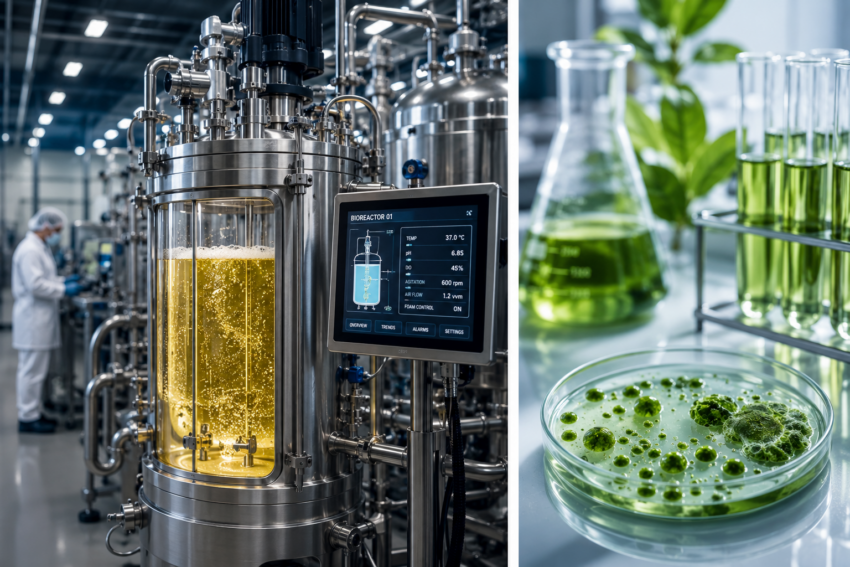
For most of industrial history, manufacturing meant one thing: taking raw materials, applying energy and machinery, and assembling something new. Steel mills, chemical plants, semiconductor fabs — all follow the same fundamental logic. We extract, refine, and construct.
But a quiet revolution is underway. And this one doesn’t rely on steel or silicon. It relies on cells.
Biomanufacturing — the use of living organisms to produce materials, medicines, fuels, and food — is transitioning from niche laboratory science to mainstream industrial strategy. The shift is not incremental. It represents a fundamental rethinking of how we make things, and why.
From Assembly Lines to Living Factories
Traditional manufacturing is a top-down process: humans design, machines execute, energy is consumed. Biomanufacturing inverts this model. Engineers program microorganisms — bacteria, yeast, algae, mammalian cells — to produce target molecules through biological processes that have been refined by evolution over billions of years.
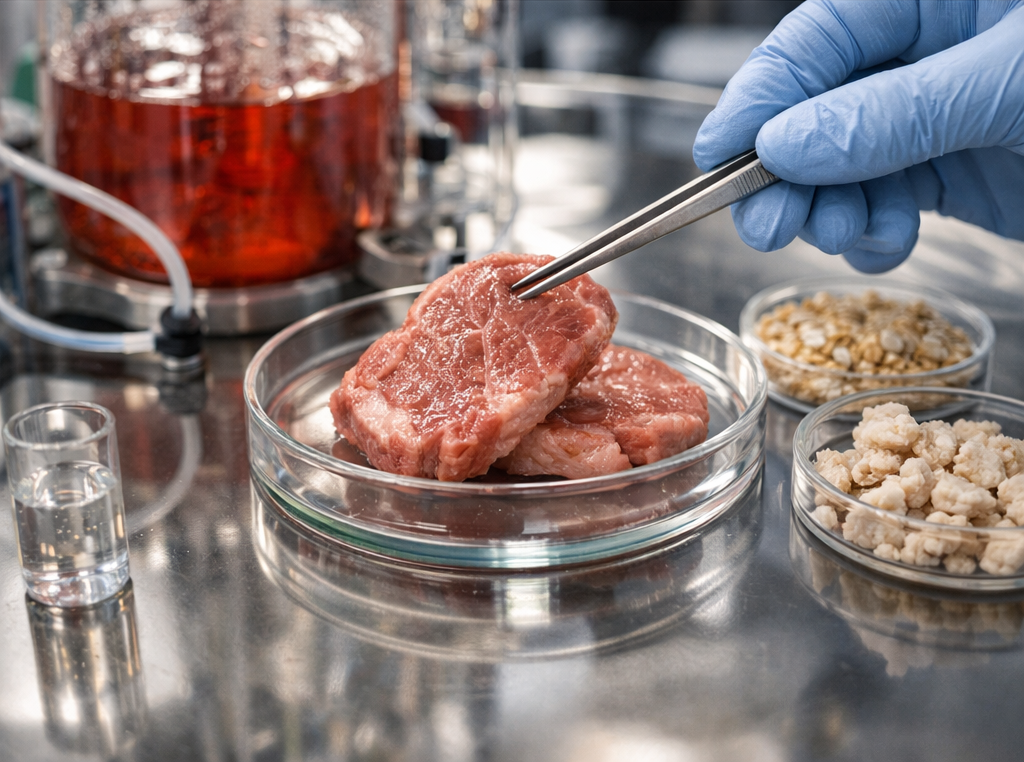
The early successes are already remarkable. Insulin, once extracted from pig pancreases in small quantities, is now produced at massive scale by genetically engineered bacteria. Spider silk — one of the strongest materials known to science — is being grown in fermentation tanks rather than harvested from spiders. Meat is being cultured directly from animal cells, bypassing agriculture entirely.
These are not science fiction scenarios. They are commercial realities in 2026.
Why Now? The Convergence of Three Forces
Biomanufacturing is not a new idea. But several technological and economic forces are converging to make it commercially viable at unprecedented scale:
- Synthetic biology tools: The cost of DNA synthesis and gene editing has collapsed. What once required years of specialized laboratory work can now be done in weeks. CRISPR and related technologies allow precise reprogramming of cellular behavior.
- AI-assisted design: Machine learning models can now predict how genetic modifications will affect cellular output — dramatically shortening development cycles and reducing trial-and-error experimentation.
- Fermentation infrastructure: The global fermentation industry, already scaled for beer, pharmaceuticals, and food processing, provides a ready infrastructure base that biomanufacturers can adapt rather than build from scratch.
When falling costs meet rising infrastructure, adoption accelerates. We are in that inflection point now.
The Industries Being Transformed
Biomanufacturing is not a single sector — it is a horizontal capability that cuts across industries:
- Pharmaceuticals: Biologics — drugs derived from living cells — already represent the fastest-growing segment of the pharmaceutical market. Vaccines, monoclonal antibodies, cell therapies, and gene therapies are all products of biomanufacturing.
- Materials: Companies are engineering microbes to produce bio-based plastics, textiles, adhesives, and construction materials that match or exceed the performance of petroleum-derived equivalents — with a fraction of the carbon footprint.
- Food and agriculture: Precision fermentation is enabling the production of dairy proteins, fats, and flavors without animals. Cultured meat startups are scaling production while regulators in multiple markets have approved commercial sales.
- Energy: Algae-based biofuels and microbially produced hydrogen represent viable pathways to decarbonizing industries where electrification is difficult.
- Chemicals: The global specialty chemicals market — worth hundreds of billions annually — is beginning to shift toward bio-based processes for everything from fragrances to industrial solvents.
No single technology reshapes this many sectors simultaneously. That is what makes biomanufacturing strategically significant.
The Sustainability Argument Is Not Just Marketing
One of the most compelling aspects of biomanufacturing is its environmental profile. Biological processes typically operate at ambient temperatures and pressures, require no toxic catalysts, and generate biodegradable byproducts. Compare that to the energy intensity of steel production, the toxicity of semiconductor manufacturing, or the carbon cost of petrochemical refining.
Living factories are also inherently renewable. A well-designed microbial production strain can be scaled using agricultural feedstocks — corn sugar, agricultural waste, even carbon dioxide captured from the air. The feedstock base is regenerative; the output is identical.
This is not greenwashing. It is a structural advantage that will drive adoption across supply chains where sustainability targets are becoming mandatory — whether driven by regulation, investor pressure, or consumer demand.
The Challenges Are Real — And Solvable
Biomanufacturing is not without obstacles:
- Scale-up complexity: What works at laboratory scale does not always translate to industrial fermentation. Managing temperature gradients, nutrient flows, and contamination in large bioreactors remains a significant engineering challenge.
- Regulatory pathways: Novel bio-based products — especially in food and materials — face complex approval processes that vary by jurisdiction and can extend timelines by years.
- Public perception: Genetic modification carries cultural baggage in many markets. Communicating the safety and benefits of engineered organisms to consumers and policymakers is an ongoing challenge.
- Talent gaps: The intersection of biology, engineering, data science, and manufacturing is rare. Building the workforce capable of scaling biomanufacturing remains a critical bottleneck.
These are not fatal obstacles. They are the friction points that separate early adopters from the mainstream market — and the entrepreneurs who solve them will capture enormous value.
What This Means for Entrepreneurs and Investors
As someone who has spent 25 years observing how technology shifts reshape industries, I see biomanufacturing as one of the most significant platform transitions of this decade. The pattern is familiar: a foundational technology matures, costs drop, infrastructure becomes available, and a wave of applications becomes commercially viable within a compressed timeframe.
We are in the early commercial phase — not the experimental phase. That distinction matters enormously for capital allocation.
For entrepreneurs: the opportunities lie not only in building production organisms, but in the enabling infrastructure — bioreactor design, quality control systems, regulatory consulting, bio-based supply chain logistics, and the software platforms that manage biological production at scale.
For investors: the question is no longer whether biomanufacturing will scale. It is which applications will scale fastest, which geographies will lead, and which business models will capture durable margin. The answers to those questions are becoming clearer every quarter.
A Closing Thought
The industrial revolution taught us to build with iron and fire. The digital revolution taught us to build with silicon and code. The biological revolution will teach us to grow with cells and sequence.
Each transition seemed improbable until it was inevitable. Biomanufacturing has crossed that threshold. The future of industry does not only depend on what we can engineer — it depends on what we can grow.
And that changes everything.
This blog post was written with the assistance of Claude (Anthropic) and ChatGPT based on ideas and insights from Edgar Khachatryan.