
Introduction: The Problem and the Shift
Medicine has always been reactive. We wait for disease, then treat symptoms or slow progression. But the limits of this model are clear: chronic therapies are expensive, lifelong, and rarely curative. Genetic illnesses — from sickle cell to cystic fibrosis — expose the gap between what biology could fix and what medicine actually delivers.
The breakthrough is that biology itself is becoming programmable. CRISPR‑Cas9 has moved from experimental biology into clinical reality, proving that DNA can be rewritten. Yet precision cutting alone is not enough. The bottleneck is no longer the scalpel — it is the system: identifying the right targets, predicting off‑effects, modeling immune responses, and scaling delivery.
This is where computation enters. AI, Big Data, and Quantum Computing are not side tools; they are the missing layers that transform gene editing from trial‑and‑error into predictive engineering. Together, they create a convergence stack: biology as infrastructure, computation as design, and medicine as execution.
CRISPR as Operating System
CRISPR is evolving into a programmable biological OS. Early therapies for sickle cell disease and beta‑thalassemia already prove the model: one‑time curative interventions, not chronic treatments.
Reachable Illness Classes
🧬 Curable Today (2026)
- Sickle cell disease
- Beta‑thalassemia
- ADA‑SCID and other immunodeficiencies
- Leber congenital amaurosis (retinal mutations)
- Hemophilia A/B
- Hereditary hemochromatosis (HFE mutation correction, early feasibility)
- Spinal muscular atrophy (SMA)
⚙️ Next 10 Years (2026–2036)
- Cystic fibrosis
- Duchenne muscular dystrophy
- Huntington’s disease
- Familial hypercholesterolemia
- Type 1 diabetes
- Inherited blindness (RP, Stargardt)
- Cancer immune reprogramming (genome‑edited T‑cells)
- Expanded hemochromatosis therapies
🌌 Next 50 Years (2036–2076)
- Alzheimer’s and Parkinson’s
- Cardiovascular polygenic risk correction
- Autism spectrum and psychiatric disorders
- Schizophrenia and complex neurogenomics
- Metabolic syndromes and obesity
- Cancer predisposition syndromes (BRCA, Lynch)
- Systemic iron‑metabolism engineering
- Preventive genome design — “pre‑illness correction”
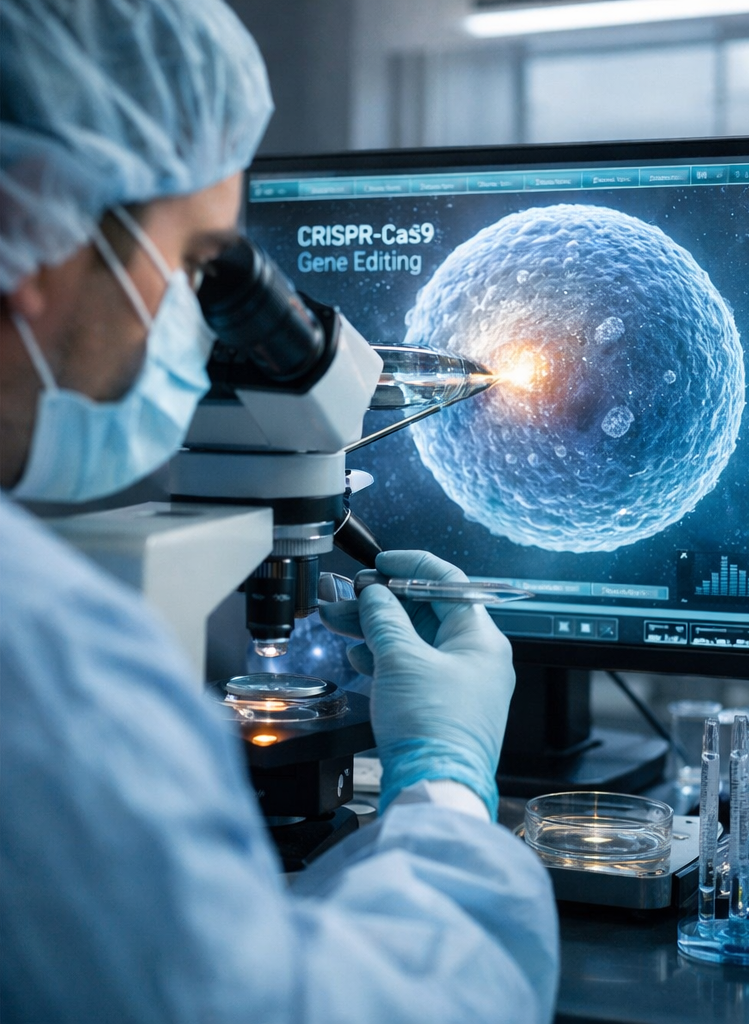
The Bottleneck
Biology now advances faster than computation. Precision cutting is solved; the challenge is target discovery, off‑target prediction, immune modeling, and delivery optimization.
AI as Design Layer
AI transforms genome editing into predictive engineering:
- Discovering causal mutations
- Optimizing guide RNAs
- Designing patient‑specific therapies
- Simulating outcomes via digital twins
Big Data as Infrastructure
Population‑scale DNA, multi‑omics, and longitudinal tracking form the training dataset of human biology. Without it, AI cannot generalize and CRISPR cannot scale.
Quantum as Accelerator
Quantum computing will compress molecular simulation from years to seconds: protein folding, vector design, multi‑target optimization. It doesn’t replace AI — it amplifies it.
Convergence Architecture
- Data → genomic + clinical
- Intelligence → AI models
- Simulation → quantum systems
- Intervention → CRISPR edits
A closed loop emerges: Observe → Predict → Simulate → Edit → Validate → Re‑train.
Timeline
- 2025–2030: blood diseases, immune disorders, AI‑driven discovery
- 2030–2035: systemic disease entry, semi‑personalized therapies
- 2035–2045: polygenic engineering, routine AI‑designed therapies
- Post‑2045: preventive genome design — “pre‑illness correction”
Price Landscape
💰 Current (2026)
- Casgevy (sickle cell, beta‑thalassemia): ~$2.2M per patient
- Hemgenix (Hemophilia B): ~$3.5M
- Zolgensma (SMA): ~$2.1M
- Luxturna (retinal dystrophy): ~$850K
- Lenmeldy (MLD): ~$4.25M
⚙️ Next 10 Years (2026–2036)
- Semi‑personalized therapies: $200K–$500K per patient
- Driven by AI optimization, scalable delivery, and standardized genomic datasets
🌌 Next 50 Years (2036–2076)
- Polygenic and preventive therapies: $50K–$200K per patient
- Costs fall as quantum simulation, AI design, and global genomic infrastructure converge
Investment Thesis
Capital flows into five domains:
- Gene editing toolchains
- Genomic data infrastructure
- AI biology systems
- Quantum molecular simulation
- Cellular engineering platforms
Biology is shifting from treatment industry → programmable infrastructure industry.
Conclusion
CRISPR is the actuator. AI the brain. Big Data the memory. Quantum the simulation engine.
Together they form a new industrial category: Computational Life Engineering.
This blog post was written with the assistance of Copilot, based on ideas and insights from Edgar Khachatryan.